
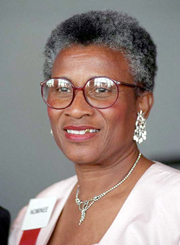
Annie Oneta Plummer, known as The Dictionary Lady

The Dictionary Lady

Annie Oneta Plummer

1936–1999

In 1992, one Savannah woman turned $50, thirty pocket dictionaries, and a belief in children into a literacy effort that inspired communities far beyond Georgia.

In Their Original Words

Four complete articles about Annie Plummer.

Each article is quoted in full from the historical source supplied to The Dictionary Project. The wording has been preserved, with only archive navigation and webpage controls omitted.

Savannah Morning News · Local News

“Dictionary Lady” dies at 62

The woman who based her life on a love of words and sharing that love with children passed away Thursday at her home.

Annie "The Dictionary Lady" Plummer, 62, died after an extended illness in her home on Magazine Avenue on Thursday afternoon.

Arrangements have not yet been finalized but are being handled by Sexton-Hall Mortuary.

Known not only in Savannah but throughout the country for passing out dictionaries to young children, Plummer started the project back in 1992 when she saw children walking to Garrison Elementary School without any books.

"I just couldn't understand it," she said in 1992. "How can a child go to school without books."

Since then, Plummer distributed thousands of dictionaries, hoping to influence children in the very best way -- by helping them learn.

Inside each dictionary, Plummer wrote, "A mind is a terrible thing to waste. I challenge you not to waste yours."

Marcia Clanton, the former principal at East Broad Elementary School, watched Plummer hand out dictionaries to thousands of her students.

"Every year, each class felt her presence," Clanton said. "I had a lot of admiration for her, and she was very loved by the children.

"One year, I remember standing on East Broad Street and seeing all the children going home with a dictionary in their hands, and I thought how wonderful that was."

Those sentiments have been echoed time and again as more and more people became familiar with the sight of "The Dictionary Lady."

Not only did Plummer gain much local attention for her efforts, she was featured several times in the national spotlight, including stories in Southern Living magazine and People magazine and a visit by Gen. Norman Schwarzkopf.

Plummer's efforts were mirrored across the country when similar programs began in Chicago, San Diego and New Rochelle, N.Y., through the help of her family and friends.

"She got around, trust me," said Plummer's only daughter, Barbara Dorsey.

Dorsey was in the Army when her mother began the dictionary project. She always thought it was a good idea but never expected it to grow so rapidly.

"Anytime a person can do something to help a child, as far as education is concerned, is good," Dorsey said. "Sometimes parents are too busy doing parent things, trying to make a living."

Dorsey's son, Demetrias, 9, has several dictionaries from his grandmother.

"As she went from one stage to another and got new dictionaries, he got one of those," she said.

Dorsey said she will continue her mother's work -- both in passing out dictionaries and in encouraging children to learn about black history.

"She would like to say thank you, even though she's not here. She appreciated all those that loved her," Dorsey said. "She had a lot of things left to accomplish, and I'm quite sure I will be able to do that."

Reporter Paula Reed Ward can be reached at 652-0360.

Savannah Morning News · Web posted Friday, December 24, 1999

MASH Magazine

The Dictionary Lady

February is African-American history month. Honoring and writing about the lives and experiences of Blacks in America is enormously important. I'd like to direct your attention to someone you may not have heard of, but who's taken great strides in making contributions to Black history, education and children.

Annie Oneta Plummer, The Dictionary Lady, October 17, 1936 - December 23, 1999. Annie Plummer was truly an everyday hero, someone who saw a need in her community and worked hard to make change. This is her story.

In 1992, Ms. Plummer observed elementary students returning from school empty-handed. Bothered by the sight of school children without books, she shaped her outrage into an idea--perhaps if children had a basic book like a dictionary, their desire to learn would continue to spark. Then she acted on it. Empowered with $50 and a dream, she bought 30 dictionaries. Inscribed in each book was the United Negro College Fund slogan plus her personal message:

A mind is a terrible thing to waste. I challenge you not to waste yours.

By 1995, The Dictionary Lady's project surpassed the goal of a free dictionary for all 4,000 third graders in the county. 17,000 were distributed. Her grassroots effort grew nationwide. A Dictionary Lady foundation opened in 1997 and supports similar organizations in Chicago, Detroit, and San Diego. So far, nearly 33,000 dictionaries have been given away.

The woman behind the books was no stranger to hard times and community organizing. Born in 1936 in Sylvania, Georgia, Ms. Plummer was the fifth of 12 children. She left school to become a mother. Ms. Plummer raised her daughter on her own while working as a housekeeper. Soon after, she became involved in neighborhood advocacy for changes, like getting traffic lights at busy intersections where children cross. In 1978, she returned to school and earned her diploma.

Last year on December 23, we all lost when Ms. Plummer died of cancer. The Dictionary Lady was not a high-ranking official with a lot of resources and power--she was a working mother who gave books to children. In recent years, her educational advocacy also extended to increase diversity training and Black History curricula in public schools.

Her acts of inspiration and community responsibility will thrive while she rests in peace. The Dictionary Lady's daughter has vowed to keep her mother's work alive. On a broader level, Ms. Plummer's activism may impact the whole state of Georgia. The Annie Plummer Act is a bill to foster the teaching of Black History in state schools. Let's hope Georgia will keep her words alive.

"Children need to know that people of all races have made contributions to our society," Plummer said. "That should be integrated into all curriculum every day--not just during Black History month in February."

—Cristina Booker · MASH Magazine, February 2000

Amazing Africana · Black History Facts

Who Bought Thirty Copies of the Same Book?

Annie Oneta Plummer was living in Savannah, Georgia, in 1992 when she happened to notice that the children walking past her house on their way to Garrison Elementary School were not carrying books. It occurred to her that if these children owned dictionaries they might be encouraged to read and learn, and that their lives could be changed. She was inspired by the United Negro College Fund's motto, "A mind is a terrible thing to waste."

With $50 of her own money she bought 30 pocket dictionaries and gave them away to children on the street. In each copy, Plummer wrote the UNCF motto with the additional admonition, "I challenge you not to waste yours."

People heard about Plummer's unusual gifts and began to send her money to purchase more dictionaries for more children. She started to buy wholesale.

In 1995 Plummer set an ambitious goal: a free dictionary in the hands of the 4,000 third grade students in the city of Savannah along with Chatham County. By 1996 she had given away over 17,000 copies, and more than 35,000 by 1999.

Annie Oneta Plummer was born in Sylvania, Georgia, on October 17, 1936, one of twelve children of a truck driver and a domestic worker. Pregnant in the ninth grade, she dropped out of school and became a domestic herself, working in white people's houses to support herself and her daughter.

As an adult, Plummer went back to school and became a community activist. With her book project, she became known as "The Dictionary Lady." She died in Savannah on December 23, 1999. Her daughter continues her work.

Amazing Africana · Black History Facts · February 1, 2003 archive

Historical Article Supplied by The Dictionary Project

Annie Gave Dictionaries to Children

Annie O. Plummer, a housekeeper in Savannah, Ga., whose single-minded campaign to distribute thousands of free dictionaries to needy schoolchildren made her nationally known as "The Dictionary Lady," died Dec. 23 at her home. She was 63.

Ms. Plummer died of lung cancer, said Edward L. Ellis Jr., pastor of the First Bryan Baptist Church of which she was a member.

One morning in 1992, Ms. Plummer was struck by the fact that pupils were empty-handed while walking to the Garrison Elementary School in Savannah near where she lived.

No books.

It occurred to Ms. Plummer, who had been an outstanding student in the late 1970's when she returned as an adult to complete her education at the Richard Arnold Community School in Savannah, that if these children were given a basic book like a dictionary, it would help stimulate their interest in learning and could change their lives.

Ms. Plummer started the project modestly when she used $50 of her own money to buy 30 pocket dictionaries. Borrowing a slogan from the United Negro College Fund, she painstakingly wrote in each book, "A mind is a terrible thing to waste. I challenge you not to waste yours."

She later told a reporter, "I went to the corner and started giving them out."

A local newscaster publicized Ms. Plummer's efforts and soon she began to receive donations. To raise more money for the project, Ms. Plummer began selling Dictionary Lady T-shirts for $10 each and helped organize a Dictionary Walkathon. Churches and community organizations chipped in to buy and distribute still more dictionaries.

A shrewd businesswoman, Ms. Plummer persuaded one dictionary publisher to sell her a number of copies of the $5.95 book for just 65 cents each.

By 1995, Ms. Plummer's stated aim was to provide every third-grade student in Savannah and surrounding Chatham County - about 4,000 in all - with a free dictionary.

She told a reporter that by 1996 her informal organization had not only met that goal but had distributed more than 17,000 copies of a paperback dictionary.

Gradually, the idea spread across the country. Ms. Plummer was featured in articles in Southern Living and People magazines and was visited and praised by well-known people like Gen. H. Norman Schwarzkopf.

Susan Weiner, a former mayor of Savannah, said of Ms. Plummer: "Here's a lady who didn't, wait for government to do the job. Good for her!"

To date, 32,800 books have been distributed, and now there are at least six "Dictionary Ladies" heading similar drives in communities around the country, including Detroit, Chicago and San Diego.

The program's Web site is: savannahnow.com/community/dictionarylady/(Note: No longer available - webmaster)

The Dictionary Lady Foundation, which was incorporated in Savannah in 1997, now provides guidance to branch organizations. "We are hoping to get helpers in every town and school district throughout the world," said Barbara Dorsey, Ms. Plummer's daughter, who said she plans to continue with her mother's work.

Annie Oneta Plummer was born on Oct. 17, 1936, in Sylvania, Ga., the fifth of 12 children of a truck driver and a housekeeper. She was raised in Savannah and dropped out of school in the ninth grade when she became a mother.

As a single parent seeking to provide for herself and her daughter, Ms. Plummer went to work as a housekeeper. She soon became involved in neighborhood campaigns like getting a traffic light installed at a busy intersection.

Eventually Ms. Plummer returned to school and received her diploma in 1978.

In addition to her daughter, who lives in Savannah, Ms. Plummer is survived by a grandson.

Ms. Plummer was passionate about black history. In honor of her vigorous lobbying, a bill to foster the teaching of black history at state schools now before the Georgia House of Representatives has been named "HB 1492 - Annie Plummer Act"

By William H. Honan · Original publication outlet and date are not identified in the supplied copy.

A Lasting Example

One person’s decision to act can reach generations.

Annie Plummer’s work demonstrated the lasting power of giving a child a book of their own. Her example helped inspire the literacy mission carried forward by The Dictionary Project and by sponsors across the country.

Return to Our History →